"Football is simple. But the hardest thing is to play football in a simple way." Johan Cruyff
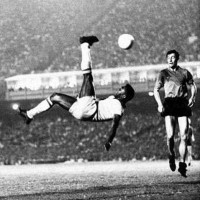
| Its all about Pele... 14/12/11A sense of nostalgia sets in when thinking of Pelé, arguably the best footballer of all times, and the one that gave “Futebol bonito” to Braziland to the rest of the world. Pelé’s memorable moments include the bicycle kick, winning three world cups for Brazil out of their total of five, and being one of the best ambassadors football could ever want and need. Nostalgia is only present because we can no longer see Pelé play football, now at 71 years of age.
Pelé paved the way for other world greats, inspiring the football played by John Cruyff and his Dutch national team, Ronaldo and the great Brazil team he led to victory in 2002, and an endless list of attacking footballers that combined a touch of power, with a whole lot of finesse, unquestionable talent, and desire to become the best.
Pelé’s career started on the streets of São Paulo in poverty, where at a young age, Pelé could not afford a football but used socks stuffed with newspapers or grapefruits as replacement. Now the biggest name in the history of football, Pelé began with a promise to his father, at only 9 years of age, that he will win a World Cup for Brazil one day. The influence of street football and futsal are very clear in Pelé’s playing style and what made him different from other footballers. He describes his career as a hard working career, that he wasn’t born the best, that he worked his way into becoming the best.
When hearing Pelé talk about his career, one thing is clear above all – he’s grateful for everything football has given him. Often “O Rei” describes football as the source of everything he has and that as he gets older, the desire to give back to the game becomes stronger and stronger. |

Understanding the 4-4-2 Diamond system 28/11/11
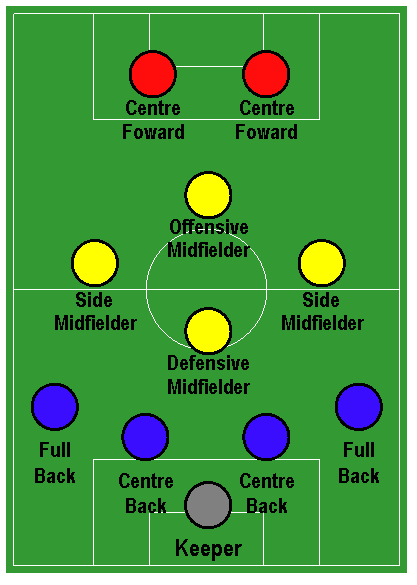 Advantages of a diamond Disadvantages of a diamond -A wide diamond is always outnumbered 2v3 in the middle of the park against any 4-5-1 variant | 1-DEFENCE
Despite the fact that there are four ways to play a diamond formation on football, the differences between them are few and usually subtle. As a starting point, one thing each of them do have in common is a back four in defence. The defence will generally have more protection in the middle than with a flat 4-4-2, especially with the 4-1-3-2 setup. As a trade-off, in a narrow diamond the wingbacks are occasionally under more pressure, while what they offer when bombing down the flank becomes more important, too. Unlike in a flat 4-4-2 where the extent of their wideplay is more often than not to overlap a flank, in a narrow diamond, wingbacks are typically the players with the most impetus in regards to attacking the byline. For this reason, the ability to get past their man and put in a cross warrants that much more attention for a manager looking to get the best out of such a system. In contrast, a wingback in a wider diamond featuring an ML and MR will not be relied on as much to provide width and will link-up with the wide-man ahead of him in a very similar way to a wide-attack from a 4-4-2. UPFRONT Of course, with 2 striker roles, the manager has plenty of options with a goal in mind. A poacher may seem an attractive option, especially with his lack of contributions to the build-up being far less recognisable than in a flat 4-4-2. Then there’s a targetman, who can hold up the ball and find an AMC / unmarked midfielder. If fluidity is favoured and the calibre of personnel allows for it, 2 complete forwards with a creative AMC behind them might be a combination which could be a daunting proposition for even the most resolute of defences. The manager has options, arguably more so than with any other formation which plays 2 utop. featuring an ML and MR will not be relied on as much to provide width and will link-up with the wide-man ahead of him in a very similar way to a wide-attack from a 4-4-2.featuring an ML and MR will not be relied on as much to provide width and will link-up with the wide-man ahead of him in a very similar way to a wide-attack from a 4-4-2. |
Midfield
he most blatant difference between a diamond and the flat 4-4-2 is how the midfield behaves. For the sake of dispelling a myth, even when playing with a narrow diamond, the flanks are anything but surrendered in the defensive phase. There is initial space to be found there, but the MCl/MCr will move across to press an opposition winger, while they will also look to pick up the run of the wingback on that side in order to prevent a possible overlap. In doing so, MCl/MCr leaves his counterpart in the middle temporarily unmarked. If it’s a 4-1-2-1-2 and 4-3-1-2 formation, the AMC will usually track back far enough to pick them up, but with a 4-1-3-2, the MC does so instantly. Either way, there is emphasis on denying space in the middle and the formation still has numbers there even when one of the central midfielders is defending a flank. It’s still a 1 player advantage in the center against a flat 4-4-2, or 3v3 when faced with a 4-5-1. There is a drawback, however, as in both cases there is an opposition wingback free should the move end up switching to the other flank. After all, the other MCl/MCr which didn’t need to go wide is still marking their opposite. If he goes wide to prevent the overlap, that leaves an unmarked CM who a spare DMC/CM must be quick to notice, especially if the AMC of a 4-1-2-1 or 4-3-1-2 doesn’t get back in time to help. This is a weakness against 4-5-1/4-3-3, and even more so against a 4-2-3-1 since the DMC will already be busy with the opposition AMC. Fortunately for the human manager who’s utilising a diamond, however, the AI is rarely able to exploit the space on the opposite flank, and so the unmarked wingback usually doesn’t come into the equation.
When going forward, with 4 players based in central midfield, the narrow diamond variant has strength through the middle that can even enjoy numerical superiority over 4-5-1 variants, let alone a flat 4-4-2. It doesn’t always going through the middle of the pitch, however, due to the fact that the AMC/MC, MCl, MCr and both strikers of a diamond system are sometimes inclined to drift out-wide even if they aren’t necessarily being funnelled to there. The option for them to attack the flank or link-up with the wingback is made even more likely when using a more adventurous philosophy. For this reason, it is definitely advantageous to have midfielders/strikers who are capable of being a threat out-wide when playing a narrow diamond variant. The narrow diamond can and will have wingplay aside from the prolonged runs of a wingback, it’s just that it comes in the form of a midfielder or striker taking the initative in exploiting any space that’s found there. It is a particularly useful course of action when there are not yet enough players who have entered the attacking phase.
, Ankara |
